 History/ Characters/ Noh Masks/ Chorus/ Instrumentalists/ Costumes/ Stage/
 Noh is a classical Japanese art form which combines elements of dance, drama, music and poetry into one highly aesthetic stage art.
Noh developed into its present form during the 14th and 15th centuries under the leadership of the distinguished performer-playwrights Kannami and his son Zeami. Zeami, in particular, wrote numerous plays, which are still performed today as a part of the classical repertoire of some 250 plays. He also wrote a number of secret papers which explained the aesthetic principles governing Noh and gave details on how the art should be composed, performed, directed, taught, and produced.
History/ Characters/ Noh Masks/ Chorus/ Instrumentalists/ Costumes/ Stage/
Noh flourished during Zeami's time under the patronage of the shogun Ashikaga Yoshimitsu (1368 ? 1394). Later during the Edo period (1603-1868), Noh became the performance art officially endorsed by the Tokugawa Shogunate. Feudal lords throughout the country supported their own troupes of Noh performers and many learned to perform the art themselves.
In the aftermath of the Meiji Restoration (1868), Noh lost the state patronage and the performers had to find the ways to support themselves. Being pushed onto the verge of extinction performers regrouped, found private sponsors, and began teaching the art to commoners as well. Their efforts paid off and the Noh slowly began to flourish again.
Today, like many classical art forms throughout the world, Noh is by no means widely popular among the general public. Nevertheless, its supporters, although they may be a minority, are enthusiastic and professional performers are highly trained and extremely busy performing and teaching throughout the country.
The main character of a Noh play is called the shite (pronounced sh'tay) who sometimes appears with one or more companion characters called tsure. In many plays, the shite appears in the first half of the play as an ordinary person, then leaves the stage for a while (nakairi=interlude), and in the second half reappears in his/her true form as the ghost of some renowned figure of the past. The former is called the maejite and the latter the nochijite. Usually, the same actor performs both of them.
The secondary actor, the waki, is often a traveling priest whose questions to the main character are important in developing the story line. He also often appears with companion waki-tsure. An interlude actor called ai or ai-kyogen also often appears as a local person who gives further background to the waki, thus enabling the audience to better understand the story setting.
The noh Kamo is somewhat different from such typical role composition, since the main characters are gods. In this noh, the maejite who appears as a local woman reappears in the latter half of the play as the companion character nochitsure (the Mother God) and the main character nochijite (the Thunder God) is the reincarnation of the arrow shown onstage in the first half of the play (see the story).
Noh masks are often used to portray a female or nonhuman (divine, demonic or animal) character. Some masks, however, represent young or old men. When used by a skilled actor, Noh masks can express various emotions. For instance, by slightly tilting one’s head forward, the actor can create a shadow on the mask which may produce a dramatic impression. In some of the stories in which the shite, the main character, is a human male, the actor may appear without a mask, but he/she would show no facial expression and act as if his/her face is a noh mask. Tsure may also wear a mask, but neither waki, the side player, nor waki-tsure, companion of the waki, wears a mask.
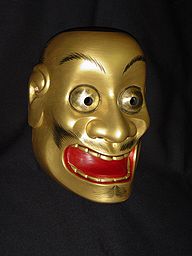 |
In the noh Kamo, the main character in the latter half of the play wears a mask called “Oh-tobide.” Oh-tobide means a startled expression. It features big eyes and a wide open mouth. It is said that O-tobide was incarnated from a public servant and became the god of thunder. It is used for roles of demons who move rapidly and violently.http://www.nohmask21.com/eu/ohtobide.html |
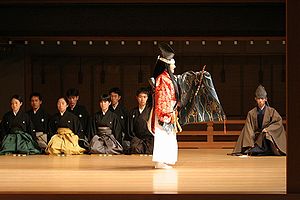 |
A chorus called jiutai, usually consisting of eight singers, sits at the side of the stage. They narrate the background of the story and set the mood of the play. They also describe the characters’ thoughts and emotions and even sing lines for them. LEFT: from left, chorus, shite (ghost of Atsumori), and waki (traveling priest). Noh “Atsumori” performed in 2004 by Kanze-kai of the University of Tokyo at National Noh Theater. |
INSTRUMENTALISTS back to the TOP
 |
Instrumentalists known as hayashi sit at the back of the stage. They consist
of a transverse flute (nohkan), an hourglass-shaped drum held at the shoulder
(kotsuzumi, see below), a slightly larger hourglass-shaped drum placed
on the lap (okawa or otsuzumi), and a barrel-shaped drum placed on a small
floor stand and played with two sticks (taiko). The rhythms and melody
of these instruments follow highly prescribed systems. s follow highly prescribed systems. One particularly unique feature is the use of drum calls (kakegoe), the shouts or cries of the drummers which serve as signals for other drummers, as well as singers. These drum calls also add an important element to the sound texture of the performance, setting the mood and establishing the tempo for the chorus. |
Costumes in noh are elaborately made with gorgeously dyed silk and intricate embroidery. These costumes reveal the type of character being portrayed and follow prescribed conventions as to their use. Still, there is much variety. The detail of design, the color combinations, the richness of texture, and the strength of form give noh its visual impact. All characters, whether rich or poor, young or old, male or female, are beautifully costumed. The costuming process is complex. Rather than the actor putting on his own costume, two or three costumers are needed to sculpt the costume on the actor.
The main part of the stage used in noh is a curtain-less square with a bridge-way leading to it from backstage. At the end of the bridge-way there is a hanging curtain, which can be lifted up to allow the characters to enter and exit. Stages were traditionally built in the open air with a long sloping roof on their top. From the late 19th century, many of them have been moved indoors. These indoor stages are open on two sides something like a square-shaped amphitheater. There is no attempt at designing a realistic stage set. Instead, a minimum number of symbolic stage properties are used. The pine tree painted on the back wall of the stage represents the tree through which noh was, by legend, passed down from heaven to mankind. In Japanese culture, the evergreen pine is an important symbol of longevity and solidity.
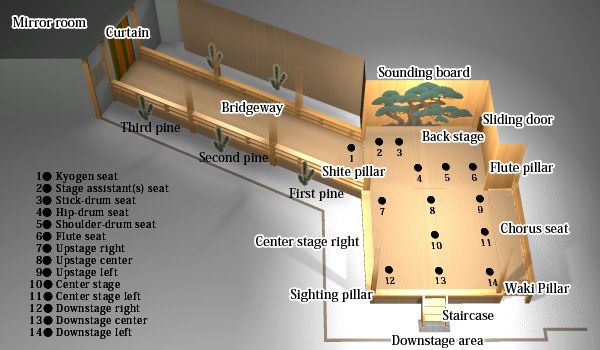 |
Noh stage: photo taken from the website of the National Noh Theater: http://www2.ntj.jac.go.jp/unesco/noh/en/stage/stage_s.html |